Sunday, July 3, 2011

Three Gorges Dam to Wuhan

The Viking Emerald arrived at the ship locks of the Three Gorges Dam at 9pm and a deck party ensued as we gathered for the 3 1/2 hour process of navigating four downward locks. As the huge metal doors opened I felt like I'd entered a Science Fiction movie. The tightness of the concrete walls, with the futuristic doors labeled with Chinese characters appeared other-worldly.  The dam is not the longest or the highest dam in the world but it is the biggest. At 1.3miles wide and 610 feet tall it is China's largest construction project since the Great Wall. The dam has been under construction for 18 years (the primary stated purpose being flood control and the secondary power generation) and when it is completed next year the water in the Yangtze will have risen over 350 feet and displaced more than one million people. Many of the displaced have used their government compensation to purchase newly built apartments. A couple of our local guides joyfully expressed satisfaction with their new accommodations. At times I wonder if our guides are simply painting the best face for China when they discuss their situations, but I do believe they are happier with electricity and non-communal toilets.
As we continued our journey to Wuhan we docked for the night in Jingzhou. This countryside along the Yangtze is flat farmland with occasional "villages" which look more like small cities me. Some of our very talented crew performed a cabaret show for us as, coincidentally, fireworks lit the sky in celebration of Communist Day. (Our waitress Joly was the choreographer and a principle dancer and Ray, our cabin steward performed a Michael Jackson inspired solo dance.) Before we departed Jingzhou we had the opportunity to visit a local school where we exchanged songs and smiles. It was a highlight of our trip.
Our Yangtze River cruise disembarked in Wuhan, a medium-sized city of 8.5 million. Before boarding our flight for Shanghai we made a stop at the Hubei Provincial Museum to see its amazing collection from the tomb of Nobleman Yi of Zeng which was discovered in 1978, complete with amazing 2500 year old artifacts made of bronze, gold, lacquer, jade and other precious materials. The prized piece is the bronze two-tone bells which were performed for us.

YANGTZE RIVER, Qutang Gorge, Wu Gorge and Lesser Three Gorges

Today was a 375 photo day. After sailing through the Qutang Gorge, all 260 passengers disembarked the Viking Century Emerald in Wushan and transferred to smaller boats for a sightseeing tour through the Dragon Gate Gorge, Misty Gorge and the Emerald Gorge in the Daning River. The ethereal peaks shrouded in mist are dramatic and clearly worthy of a painter's brush. When we reboarded our vessel after a 3-hour tour (which included rhesus monkey sightings) we planted ourselves on the observation deck for another 3-hours to enjoy the rural landscape and take more vertical shots through the Wu Gorge. I hope you enjoy these photos of our bliss-filled day!

YANGTZE RIVER, Shibaozhai

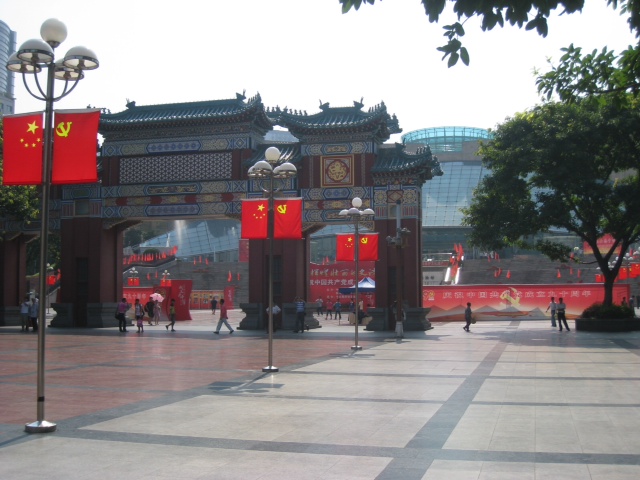
We boarded the Viking Century Sun in Chongqing (city with the largest population in China with 32 million people) after a quick tour of the the temple square that marks the center of this hilly city surrounded by mountains. (There is a new Three Gorges Dam Museum in Chongqing - photo below - that houses many treasures that would have been submersed by the flooding created by the dam.) We reached our ship via funicular and settled into our stateroom with a view of the Chongqing Opera House and unpacked for our five day cruise along the Yangtze River to Wuhan.
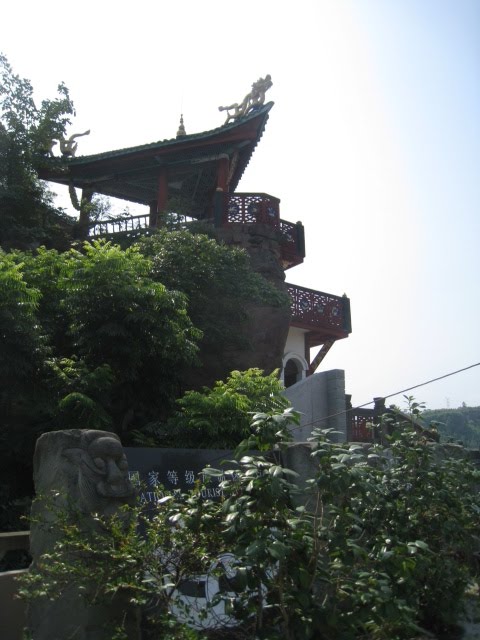
Our first port of call was Shibaozhai, and the affects of the flooding due to the Three Gorges Dam were immediately visible. A retaining wall has been constructed around the base of the 350 year old Shibaozhai Pagoda. It once sat at the the top of a high mountain and is now near river level. Our trek to the pagoda entailed a fifteen minute walk up a steep hill, through a souvenir vendor lined street, over a pedestrian suspension bridge, followed by a climb to the top of the 16 story pagoda. Okay, so that doesn't sound too difficult but add 100-degree temperatures with a matching humidity and reaching the pinnacle resulted in a sweat-filled celebration!

Xi'an, China

Xi'an is one of the birthplaces of civilization. It has seen 3,100 years of development and 13 dynasties, giving it equal fame with Athens, Rome and Cairo as one of the four major ancient civilization capitals. Xi'an means Western Peace and it is the starting point of the famed Silk Road. The first emperor of China, Qin Shi Huang, unified China, built The Great Wall and funneled the dynasties resources toward assembling his afterlife tomb, including his thousands of life-size terra cotta soldiers, each with a unique face and uniform.

These soldiers were first discovered in 1972 when 5 local farmers attempted to dig a well. Archaeologists estimate there were 6000 soldiers, along with horses and chariots in just one of the four pits built for Emperor Qin.  When they were found, having been buried for over 2,000 years, most were broken into many parts because there were wooden roofs covering the soldiers and over time, as the weight of the soil crushed the roofs, the soldiers were shattered. The archeological project of excavating and piecing each warrior back together will likely be continuing for the next 2000 years from what I see of the work in front of them.
Our visit to Xi'an also included a Tang Dynasty Acrobat show and a stay at the Kempinski hotel (shown in the first photo). The buffet breakfast matched the variety and expanse of the breakfasts we enjoyed in Beijing. One of my favorite treats is the dim sum, like this slightly sweet pumpkin dumpling. The Kempinski also included gas masks in each room. We couldn't get an explanation for this from Iowa but it provided amusing dinner conversation.