Sunday, July 3, 2011

Xi'an, China

Xi'an is one of the birthplaces of civilization. It has seen 3,100 years of development and 13 dynasties, giving it equal fame with Athens, Rome and Cairo as one of the four major ancient civilization capitals. Xi'an means Western Peace and it is the starting point of the famed Silk Road. The first emperor of China, Qin Shi Huang, unified China, built The Great Wall and funneled the dynasties resources toward assembling his afterlife tomb, including his thousands of life-size terra cotta soldiers, each with a unique face and uniform.

These soldiers were first discovered in 1972 when 5 local farmers attempted to dig a well. Archaeologists estimate there were 6000 soldiers, along with horses and chariots in just one of the four pits built for Emperor Qin.  When they were found, having been buried for over 2,000 years, most were broken into many parts because there were wooden roofs covering the soldiers and over time, as the weight of the soil crushed the roofs, the soldiers were shattered. The archeological project of excavating and piecing each warrior back together will likely be continuing for the next 2000 years from what I see of the work in front of them.
Our visit to Xi'an also included a Tang Dynasty Acrobat show and a stay at the Kempinski hotel (shown in the first photo). The buffet breakfast matched the variety and expanse of the breakfasts we enjoyed in Beijing. One of my favorite treats is the dim sum, like this slightly sweet pumpkin dumpling. The Kempinski also included gas masks in each room. We couldn't get an explanation for this from Iowa but it provided amusing dinner conversation.

Thursday, June 30, 2011

Beijing Hutong

Before our afternoon flight to Xi'an our driver dropped us off at the Drum and Bell Towers. These sit on the center axis of Beijing with the Forbidden City anchoring the South and now the Olympic Bird's Nest to the North. The bell tower marked time for Beijing people before the cultural revolution. Evidently the first item people bought after the revolution - with several month's salary - was a watch. The towers now serve as tourist sites with frequent ceremonial performances.

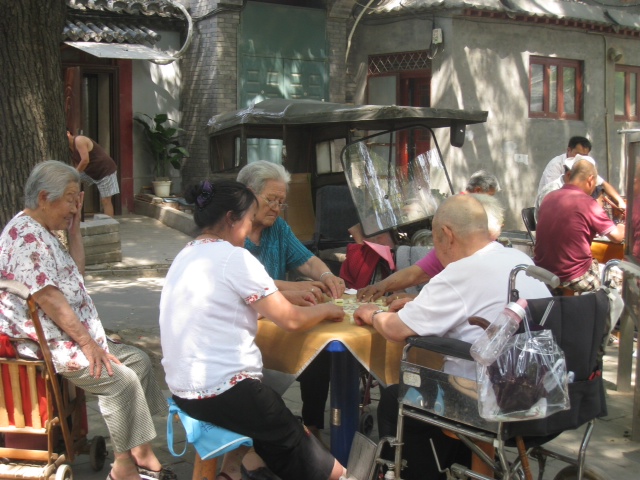
The government of China has designated a couple dozen Hutong communities as historic sites, though most have been torn down and replaced with modern buildings. The narrow alleyways are lined with primarily gray-walled windowless structures with periodic entryways that lead to family homes and complexes. Though some residents are enjoying economic prosperity, they have no access to sewage systems and must use common communal toilets that are owned and operated by the government. A monthly fee is charged for this convenience. The well off are able to upgrade their homes with solar showers, but no toilets.
After a rickshaw ride dodging bicycles, scooters, cars and pedestrians all jockeying for right of way we visited the home of Mrs. Wong which is right next door to a bed & breakfast - a new concept in this neighborhood.  Mrs. Wong's home is 200 years old and has accommodated five generations of relatives. The lovely center courtyard has a bedroom and living room in the North rooms and kitchen and dining room to the South. (Note Mrs. Wong's sinkless kitchen!)
I always feel like a voyeur on excursions like this and try to be discreet as I snap photos. Yet these images of daily life are some of my favorite. I hope you enjoy these glimpses of our rickshaw ride around a Beijing Hutong.

Postscript: Aboard our flight to Xi'an we were treated to views of the Great Wall and mountainous regions draped with farming steppes. Beautiful!

Sunday, June 26, 2011

Great Wall of China

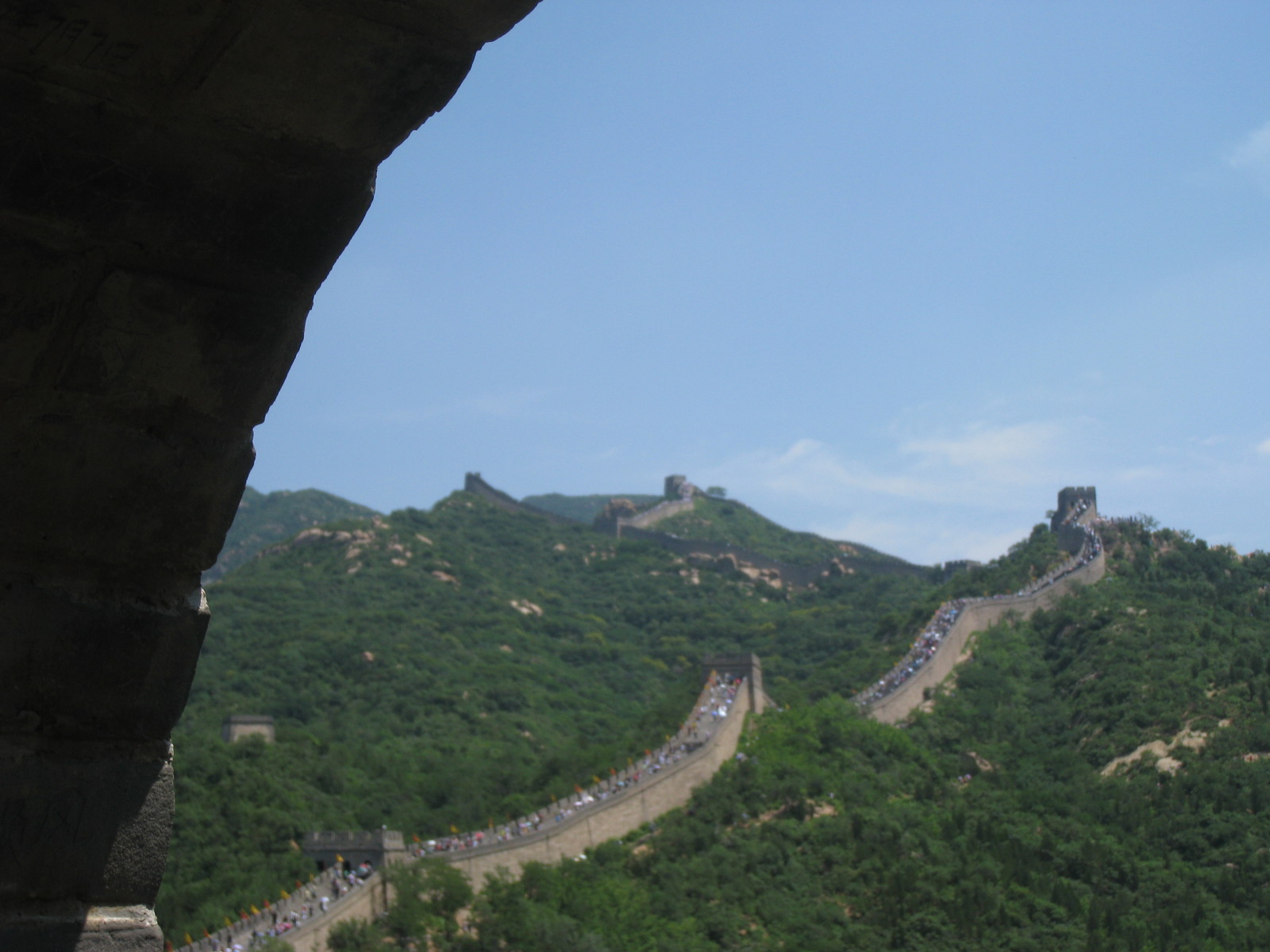
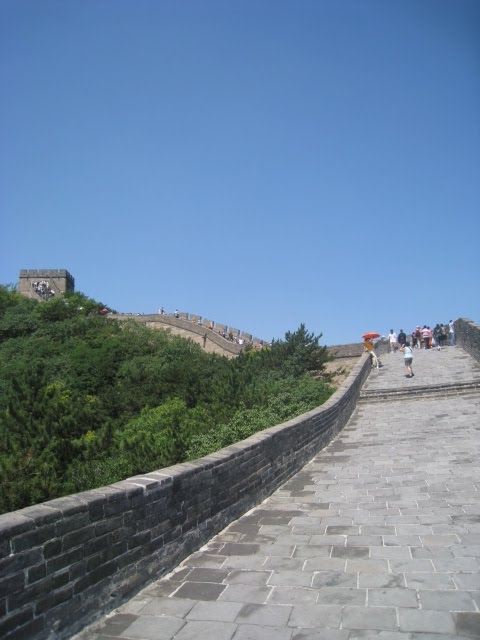
We are now authentic heroines. We have climbed the Great Wall! We travelled 1 1/2 hours to the Badaling Hills where the Great Wall is strung like Christmas lights throughout the steep mountain peaks and valleys and dotted with guard towers rather than twinkling lights. At the base of the Badaling entrance Iowa introduced us to our two ascent options as "hard and harder." We chose harder for the promise of lighter crowds. 45 minutes later we reached the highest tower in this section of the wall having climbed steep, uneven, ladder-like stairs and harder roller coaster grade ramp-like sections. The mountain views were striking in their elegant simplicity highlighted by the snaking barrier stretching to infinity.
Our cool-down for the afternoon included a one-mile stroll along The Sacred Way of the Ming Tombs. This sacred way is lined with bookended stone sculptures including warriors, elephants, camels, horses and additional essential elements worthy of the 13 great Ming emperors entombed in this area.
The day was topped-off with a Beijing (Peking) duck dinner followed by two short Beijing (Peking) Opera performances. It is considered one of China's precious treasures and was a treat to experience. Another highlight of the day was a jade carving factory. The jade that appealed to us were exquisitely carved museum-like pieces in the $20,000-plus category. The complexity and beauty of these belong on some seven-wonder list.

BEIJING Palaces

Our official tour started today and we are delighted with our tour guide Iowa (not his real name of course but his Chinese name sounds similar). He will travel with us all the way to Shanghai and thankfully he is warm and funny in a very sweet way. 

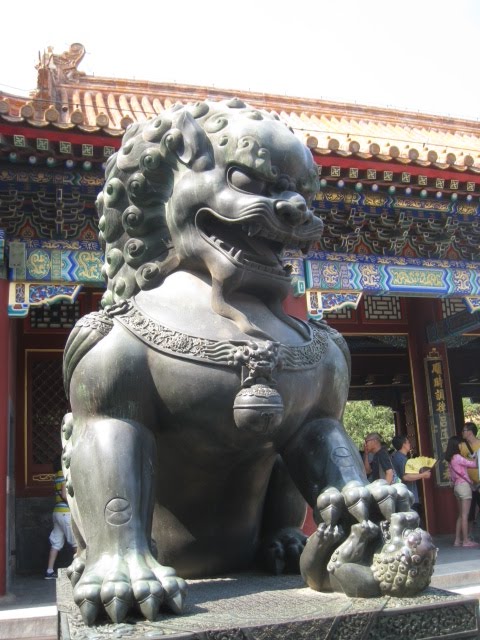
Iowa escorted us through Tiananmen Square, The Forbidden City and The Summer Palace with ease. Chairman Mao's presence is palpable in the square with his permanent portrait looking on from Tiananmen Gate and his even more permanent body on display in the crystal tomb. The patient crowds waiting daily to view the late Chairman in his preserved state hint at the massive population in China.
As the crowds inevitable drifted North to enter The Forbidden City I wondered what Chinese "commoners" feel as they step over these once forbidden thresholds. Do they view this fabled palace with reverent awe or do they wonder, as I did, how such opulent excess could be lavished upon one man (or Dragon Lady) while the majority subsisted on noodles or rice? 9,999 rooms -many filled with precious jades, tapestries and Chinese screen paintings - have remained virtually untouched and we commoners are now permitted to peer into unlit rooms to view a moment in history. It would take weeks to wander all the labyrinthian passages. To view the thrones in the Hall of Central Harmony and Hall of Supreme Harmony we employed the delicate art of pushing to obtain our views. It seems that is basically how it is done here. Other than at security checkpoints, the 80,000 visitors per day are not herded into tidy lines. Nor is every ledge and missing paving stone marked with yellow tape or handrail; and I'm finding this "here it is, have at it" approach surprisingly liberating and refreshing.
At The Summer Palace we boarded dragon boats destined for the base of the hills created by the dirt excavated from the manmade lake. With the beauty of the Western Mountains in the background I imagine the sublimity of having this as my private playground. I wonder if I, like the Dragon Lady, would be content sitting at the shore in my marble boat. Would I find the expanse of my private temples and pavilions, protected by walls snaking up the hills, to be a palace or a prison? Today, I am simply grateful for the opportunity to be here and to experience the majestic splendor.